the interference problem
continuous batching keeps the GPU busy by scheduling at iteration granularity. but one edge case breaks the latency story: long prefills.
when a request arrives with a 2048-token prompt, the scheduler runs it through prefill in a single iteration. on an A100, a 2048-token prefill for a 7B model takes roughly 200 ms. all the decode requests already in the batch are blocked for the entire duration.
time ──────────────────────────────────────────────────────────────────►

iter 1:  [Req A prefill: 2048 tokens — 200 ms                         ]
         ←────────────────────────────────────────────────────────────→
         Req B, C, D (decode) are ALL blocked for 200 ms

iter 2:  [A dec][B dec][C dec][D dec]  ← 5 ms
iter 3:  [A dec][B dec][C dec][D dec]  ← 5 ms
...
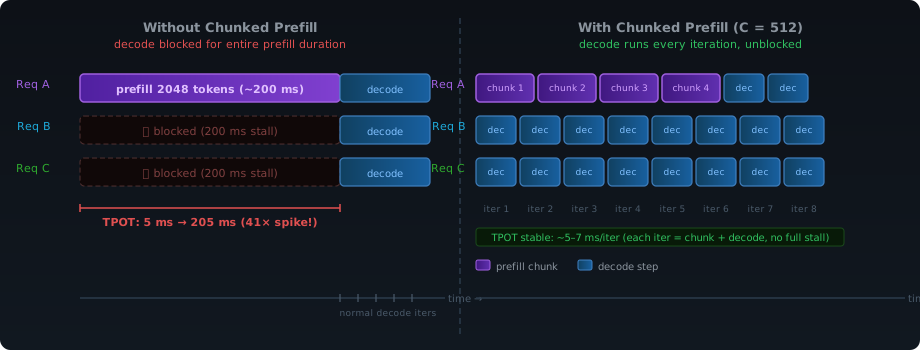
Figure 1: without chunked prefill (left), a 2048-token prefill blocks all decode requests for ~200 ms, spiking TPOT 41×. with chunked prefill at C = 512 (right), decode runs every iteration with minimal overhead.
from the perspective of Req B, C, and D, their TPOT (time per output token) just jumped from 5 ms to 205 ms for one step. users notice this as an irregular “stutter” in streaming output.
this is prefill-decode interference: the compute-bound prefill (GEMM) monopolizes the GPU, starving the latency-sensitive decode (GEMV).
the two metrics pulled in opposite directions:
| optimization | TTFT (time to first token) | TPOT (time per output token) |
|---|---|---|
| large prefill, run all at once | ↓ low — KV cache ready quickly | ↑ high — decode blocked |
| delay prefill, prioritize decode | ↑ high — new request waits | ↓ low — decode unaffected |
you can’t minimize both simultaneously — unless you slice the prefill.
chunked prefill: the core idea
chunked prefill splits a long prompt into segments of size \(C\) (the chunk size) and processes one segment per iteration, interleaved with decode steps:
without chunked prefill (C = 2048, full prompt):

  iter 1: [A prefill: 2048 tokens]
  iter 2: [A dec][B dec][C dec]
  iter 3: [A dec][B dec][C dec]

with chunked prefill (C = 512):

  iter 1: [A: tokens    0–511] [B dec][C dec]
  iter 2: [A: tokens  512–1023][B dec][C dec]
  iter 3: [A: tokens 1023–1535][B dec][C dec]
  iter 4: [A: tokens 1536–2047][B dec][C dec]
  iter 5: [A dec]              [B dec][C dec]  ← A now in decode
each iteration processes a fixed token budget \(T\):
$$
T = C_{\text{prefill}} + N_{\text{decode}}
$$
where \(C_{\text{prefill}}\) is the number of prefill tokens processed this iteration and \(N_{\text{decode}}\) is the number of running decode requests. the scheduler enforces \(C_{\text{prefill}} + N_{\text{decode}} \leq T\).
decode requests continue running at every iteration. their TPOT becomes roughly:
$$
\text{TPOT} \approx \frac{\text{compute}(C_{\text{prefill}} + N_{\text{decode}})}{\text{compute}(N_{\text{decode}})} \times \Delta t_{\text{decode}}
$$
with \(C = 512\) and \(N_{\text{decode}} = 32\), the TPOT overhead from a prefill chunk is small: 512 tokens of GEMM adds far less than a full 2048-token prefill would.
correctness and cost model
why chunked prefill is mathematically exact
does slicing the prefill change the result? no — it is exactly equivalent to running the full prefill at once. here is why.
recall that decoder-only transformers use causal attention: position \(i\) only attends to positions \(j \leq i\).
suppose the prompt is \([t_1, t_2, \ldots, t_L]\), split into chunks of size \(C\). chunk \(s\) handles tokens \([(s-1)C+1, \ldots, sC]\).
for any token \(t_i\) in chunk \(s\):
- tokens \(j < (s-1)C + 1\) are from prior chunks — their \(k_j, v_j\) were computed in earlier iterations and stored in the KV cache
- tokens \(j \in [(s-1)C+1, i]\) are in the current chunk — \(k_j, v_j\) are computed this iteration
so the attention for \(t_i\) splits into two parts:
$$
\begin{aligned}
\text{attn}_{i} = \text{softmax_merge}\Bigl(
&\underbrace{\frac{q_i \cdot K_{\text{cache}}^T}{\sqrt{d_k}}}_{\text{attend to prior chunks}},;
\underbrace{\frac{q_i \cdot K_{\text{chunk}}^T}{\sqrt{d_k}}}_{\text{attend within current chunk}}
\Bigr) \cdot \begin{bmatrix} V_{\text{cache}} \ V_{\text{chunk}} \end{bmatrix}
\end{aligned}
$$
where softmax_merge is the online softmax merge (same trick as paged attention’s block-level aggregation). FlashAttention’s flash_attn_varlen_func handles this natively — the cu_seqlens parameter tells it each token’s effective context length (cache history + current chunk).
after each chunk, the newly computed \(k, v\) vectors are written to the KV cache:
$$
K_{\text{cache}} \mathrel{+}= [k_{(s-1)C+1}, \ldots, k_{sC}]
$$
the next chunk sees this extended cache. by induction, after all \(\lceil L/C \rceil\) chunks, the KV cache contains exactly what a full-prompt prefill would have produced — the final decode step is indistinguishable from the non-chunked case.
TTFT/TPOT tradeoff and chunk size selection
chunk size \(C\) is the key tuning knob:
$$
\text{TTFT} \approx \left\lceil \frac{L_{\text{prompt}}}{C} \right\rceil \times \Delta t_{\text{iter}}
$$
$$
\text{TPOT jitter} \propto \frac{C}{N_{\text{decode}}} \times \frac{\text{FLOP}_{\text{GEMM}}}{\text{FLOP}_{\text{GEMV}}}
$$
- larger \(C\): fewer iterations to complete prefill → lower TTFT. but each prefill chunk is larger → more decode interference per iteration → higher TPOT jitter.
- smaller \(C\): decode runs with minimal interference → stable TPOT. but prefill needs more iterations → higher TTFT.
the sweet spot depends on the ratio of active decode requests to prefill tokens. typical production defaults:
| engine | default chunk size |
|---|---|
| vLLM (v0.4+) | 512 tokens |
| SGLang | 512 tokens |
| TensorRT-LLM | 1024 tokens |
with \(C = 512\) and a 2048-token prompt: 4 iterations to complete prefill, each adding just 512 tokens of GEMM overhead to the decode step. total TTFT increase versus full-prefill: \(3 \times 5\text{ ms} = 15\text{ ms}\) — negligible for most use cases.
FLOPs analysis: no overhead from chunking
an important sanity check: does chunking add FLOPs? the answer is no.
for a single transformer layer, causal attention touches \(L(L+1)/2\) query-key pairs. counting both \(QK^T\) and \(\text{attn} \cdot V\), attention FLOPs are:
$$
\text{FLOP}_{\text{attn}}(L) \approx 4d \cdot \frac{L(L+1)}{2} + 4Ld^2
$$
the first term comes from causal attention pairs; \(4Ld^2\) comes from the four projection matrices.
without chunking: one call with \(L\) tokens.
with chunking: \(\lceil L/C \rceil\) calls, each processing new prompt tokens against an expanding KV cache. the total attention FLOPs across all chunks:
$$
\begin{aligned}
\text{FLOP}_{\text{chunk-attn}}
&= 4Ld^2 + 4d \sum_{i=1}^{L} i \\
&= 4Ld^2 + 4d \cdot \frac{L(L+1)}{2}
\end{aligned}
$$
exactly the same as the non-chunked case. chunking distributes the same FLOPs across more iterations — it does not add computation.
IO overhead: negligible in practice
the one real cost is writing new KV vectors to HBM at the end of each chunk. for chunk size \(C\), model with \(n_h\) KV heads, head dim \(d_h\), \(L_{\text{layers}}\) layers, and BF16:
$$
\text{write per chunk} = C \times 2 \times L_{\text{layers}} \times n_h \times d_h \times 2 \text{ bytes}
$$
for LLaMA-3 8B (\(L = 32, n_h = 8, d_h = 128\)) and \(C = 512\):
$$
512 \times 2 \times 32 \times 8 \times 128 \times 2 = 67{,}108{,}864 \text{ bytes} \approx 64 \text{ MB}
$$
at A100’s HBM bandwidth of ~2 TB/s:
$$
\frac{64 \times 10^6}{2 \times 10^{12}} = 32 \text{ μs}
$$
32 microseconds, compared to an iteration time of ~5 ms. the IO overhead is <1% of iteration cost — genuinely negligible.
how it composes with the serving stack
interaction with prefix caching
chunked prefill and prefix caching compose nicely. if the first \(k\) blocks of a prompt are already in the cache, those blocks are skipped entirely:
prompt: [system prompt — 1024 tokens][user query — 1024 tokens]
             (cached — skip)              (must compute)

with prefix cache + chunked prefill (C = 512):
  iter 1: [user query tokens   0–511]   ← only 2 chunks instead of 4
  iter 2: [user query tokens 512–1023]
  iter 3: [decode]
the effective prefill length after a cache hit is only the uncached suffix. TTFT drops further, and fewer iterations are consumed for prefill.
scheduler implementation
the scheduling logic in SGLang looks roughly like:
| |
the key property: prefill_this_iter can be less than remaining_prefill, capturing the “partial” prefill. the next iteration the scheduler picks up where it left off.
comparison with disaggregated prefill
chunked prefill is the in-place solution to prefill-decode interference: both still share the same GPU, just interleaved more carefully.
disaggregated prefill takes the more radical approach: route prefill to separate machines entirely, so decode GPUs never see prefill traffic at all.
| dimension | chunked prefill | disaggregated prefill |
|---|---|---|
| hardware requirement | single GPU / node | separate prefill + decode pools |
| TPOT | significantly improved | optimal (zero interference) |
| TTFT | slightly increased (chunking adds iterations) | significantly better (dedicated prefill resources) |
| network overhead | none | KV cache migration across nodes |
| implementation complexity | low (scheduler-only change) | high (cluster coordination) |
| when to use | general production serving | large-scale, SLO-critical deployments |
a full treatment of disaggregated prefill is in the next post.
summary
chunked prefill is arguably the best-value optimization in LLM serving:
- zero FLOPs overhead — chunking distributes the same work, not more work
- negligible IO overhead — ~32 μs of KV writes per chunk vs 5 ms iteration time
- straightforward implementation — only the scheduler changes; the attention kernel is unmodified
- significant TPOT improvement — decode requests no longer stall for long prefills
- composable — works naturally with prefix caching (skip cached chunks), paged attention (KV written block by block), and continuous batching (same iteration-level loop)
the only cost is a modest increase in TTFT proportional to the extra scheduling iterations, roughly \((\lceil L/C \rceil - 1) \times \Delta t_{\text{iter}}\), which in practice is well within acceptable bounds.