The Short Answer
Models do not use only floating-point types. Integers appear too. The useful distinction is not simply “float versus int”, but where the type is used.
| Location | Common types | Purpose |
|---|---|---|
| Training compute | FP32, TF32, FP16, BF16 | Keep gradients and activations stable while using Tensor Cores |
| Inference compute | BF16, FP16, FP8, INT8 | Reduce bandwidth and compute cost |
| Weight storage | BF16, FP16, FP8, INT8, INT4, NF4 | Shrink model files and GPU memory |
| KV cache / activation | BF16, FP16, FP8, INT8 | Save memory for long context and high concurrency |
| token ids / masks / indices | INT32, INT64, bool | Represent discrete structure, not quantized parameters |
One sentence is enough for the main idea: training is usually dominated by floating-point compute; inference and storage often use low-precision floating point and integers; when integers represent model values, they usually need a scale, zero point, or codebook to become approximate real numbers again.
For example, if a weight is w = 0.15625, INT8 storage might look like this:
| |
The integer is a compact code. The model still cares about the decoded approximate real value.
Floating Point: Range Versus Precision
A floating-point value has three parts: sign, exponent, and mantissa. The sign stores positive or negative. The exponent decides how far the number line reaches, or range. The mantissa decides how dense nearby tick marks are, or precision.
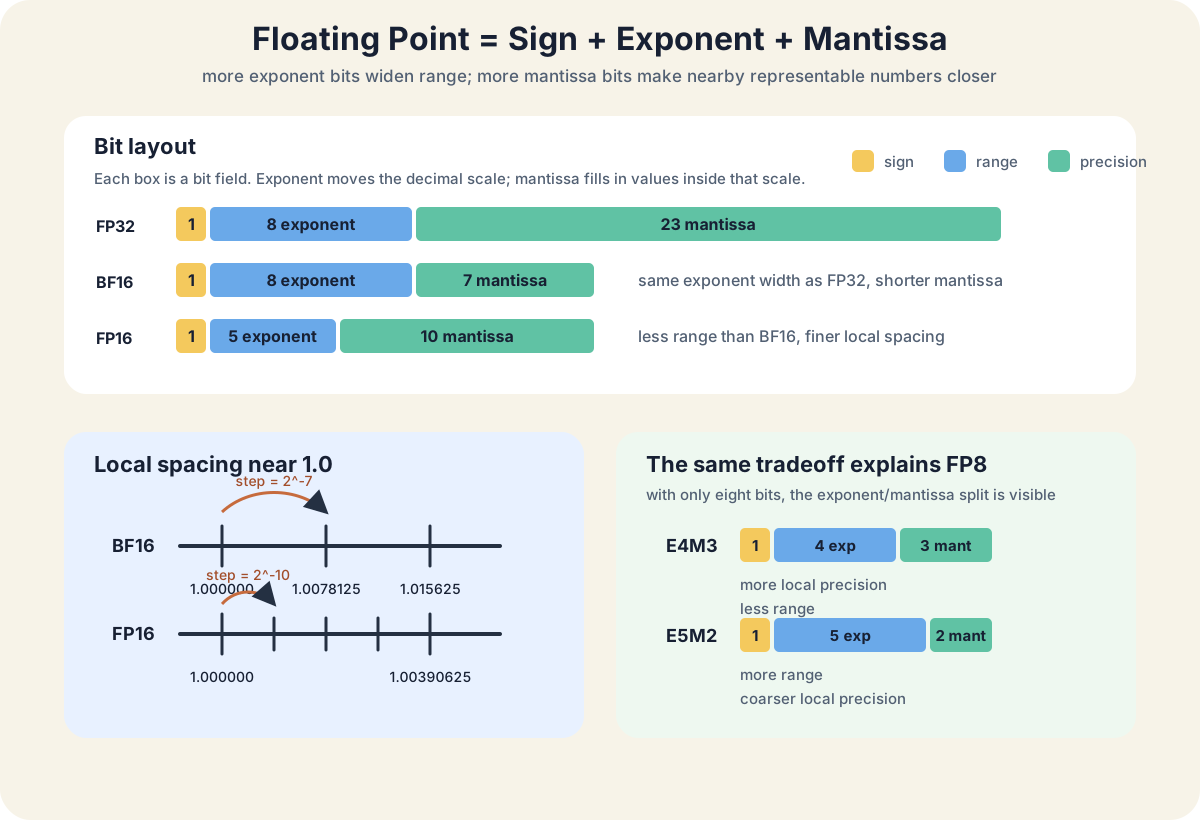
Figure 1: Floating-point formats split bits into sign, exponent, and mantissa. Exponent decides how far the number line reaches; mantissa decides how dense nearby tick marks are. FP8 E4M3 / E5M2 is the same tradeoff under a tighter budget.
BF16 and FP16 are both 16-bit formats, but they spend those bits differently:
- BF16: 1 sign + 8 exponent + 7 mantissa. It keeps an FP32-like range but has coarser local precision.
- FP16: 1 sign + 5 exponent + 10 mantissa. It has less range but denser spacing near the same magnitude.
Near 1.0, BF16’s next representable value is about 2^-7 = 0.0078125 away. FP16’s step is about 2^-10 = 0.0009765625. FP16 is therefore roughly 8x denser near 1.0, while BF16 is less likely to overflow or underflow when magnitudes change.
The common floating-point formats are:
| Type | Core intuition | Common use |
|---|---|---|
| FP32 | Large range and high precision, but expensive in memory and bandwidth | optimizer states, master weights, some accumulation paths |
| TF32 | FP32 range with a shorter mantissa, NVIDIA Tensor Core friendly | accelerated FP32 matmul on Ampere and newer GPUs |
| FP16 | finer local precision than BF16, smaller range | mixed precision training and inference |
| BF16 | FP32-like range, coarser local precision | common baseline for modern LLM training and inference |
| FP8 E4M3 | more mantissa, better local precision | weight / activation paths |
| FP8 E5M2 | more exponent, wider range | gradients or tensors with larger dynamic range |
Integers: Indices Are Not Quantization
There are two kinds of integers in model systems.
The first kind is ordinary discrete data: token ids, position ids, attention masks, MoE routing indices, and embedding lookup indices. These values are labels or control data. token id = 42 means the 42nd vocabulary entry, not a model parameter approximately equal to 42.0.
The second kind is quantized numeric data:
| Type | Common target | Interpretation | Main benefit |
|---|---|---|---|
| INT8 | weights, activations, KV cache | scale / zero point | saves memory and bandwidth; some hardware has high throughput |
| INT4 | mostly weights | group-wise scale | sharply reduces weight memory |
| NF4 | QLoRA weight codes | non-uniform codebook | better 4-bit fit for roughly normal weight distributions |
Be careful with phrases like “INT4 model”. They often mean weights are stored in 4 bits. The kernel may still decode those weights into FP16/BF16 and accumulate in higher precision. It does not mean every operation is performed as 4-bit integer arithmetic.
Three Questions for Any Dtype
Do not treat dtype as one label. A matmul has at least three layers:
| Question | Example |
|---|---|
| storage dtype: how is the tensor stored? | weights stored as INT4, scales stored as FP16 |
| compute dtype: what enters the multiply path? | activations are BF16; weights are decoded inside the kernel |
| accumulation dtype: how are products summed? | BF16 multiply with FP32 accumulation |
Accumulation matters because matrix multiplication sums many products. Inputs can be low precision, but the intermediate sum often needs higher precision; otherwise error accumulates across the hidden dimension.
When reading a paper, model card, or serving config, ask three questions:
- Does this dtype describe weights, activations, KV cache, gradients, optimizer states, or token/index data?
- Is it storage, compute, or accumulation?
- If it is integer numeric data, where are the scale, zero point, or codebook? Is the granularity per-tensor, per-channel, or per-group?
This keeps the vocabulary from blending together. BF16, FP16, and FP8 are mainly about allocating exponent and mantissa bits. INT8, INT4, and NF4 are mainly about approximating a real-valued distribution with fewer bits. INT32 and INT64 token ids are ordinary indices.
For follow-up reading, use this post as the entry point: resource estimation is in Estimating LLM Training and Inference Compute and Memory, while quantization error and codebooks are in A Survey of LLM Quantization: From Linear Quantization to Codebooks.